Kastanienallee 42 · 10435 Berlin · Kastanienallee Studio
Production workflow from inquiry to delivery
First-time clients want to know what happens and in what order. The workflow below describes how a project typically runs with us. It is not a rigid rule, but a guide that all parties can follow. If your project deviates from this, let us know, and we will adjust the sequence.
The process is divided into eight stages, from the initial inquiry to the archived file. At the end, you will find the most frequently asked questions before any booking.
- Available
- Mon–Fri, 09:00–18:00
- Response
- short response time after inquiry
- Phone
- +49 30 12345678
- cadendunnvfoc@hotmail.com
Inquiry and initial assessment
The process begins with a short inquiry.
State the project type, desired timeframe, and whether video is included. If a template or brief is available, please attach it. Within a short response time, we will tell you if the date is realistic or if we suggest another time. In this phase, we also clarify whether a DPA (Data Processing Agreement) is necessary, as this affects the start of the project.
As a recording studio in Berlin for interview recordings, we receive many inquiries from editorial offices and companies that need a broadcast-ready sound bite. The clearer the inquiry, the faster the assessment. If you are still unsure whether your project fits into the workflow, you can leave that point open and clarify it in a conversation.
- To bring
- Project type, timeframe, video yes/no
- Optional
- Template or brief
- Clarification
- Whether a DPA is necessary
Preparation and technical coordination
Before the shoot, we coordinate the technical points that would otherwise cost time later. This includes the number of speakers, camera, target format, and whether a remote connection is planned. For TV productions, we mentally walk through the setup before it is built. For voice recordings, a short phone call is often sufficient. The goal of this phase is to ensure that only recording happens on the day of the shoot.
The workflow in eight stages
From inquiry to archived file. Each stage has a task that prepares for the next one.
Inquiry
Inquiry and initial assessment
State project type, timeframe, and video yes/no. We check feasibility and get back to you within a short response time.
Preparation
Technical coordination
Number of speakers, camera, target format, and remote connection are clarified in advance. On the day of the shoot, we only record.
Setup
Setup on the day of the shoot
Microphones, lighting, camera, and seating are checked before the first guest arrives. For live setups, the audio loop is tested.
Recording
Recording
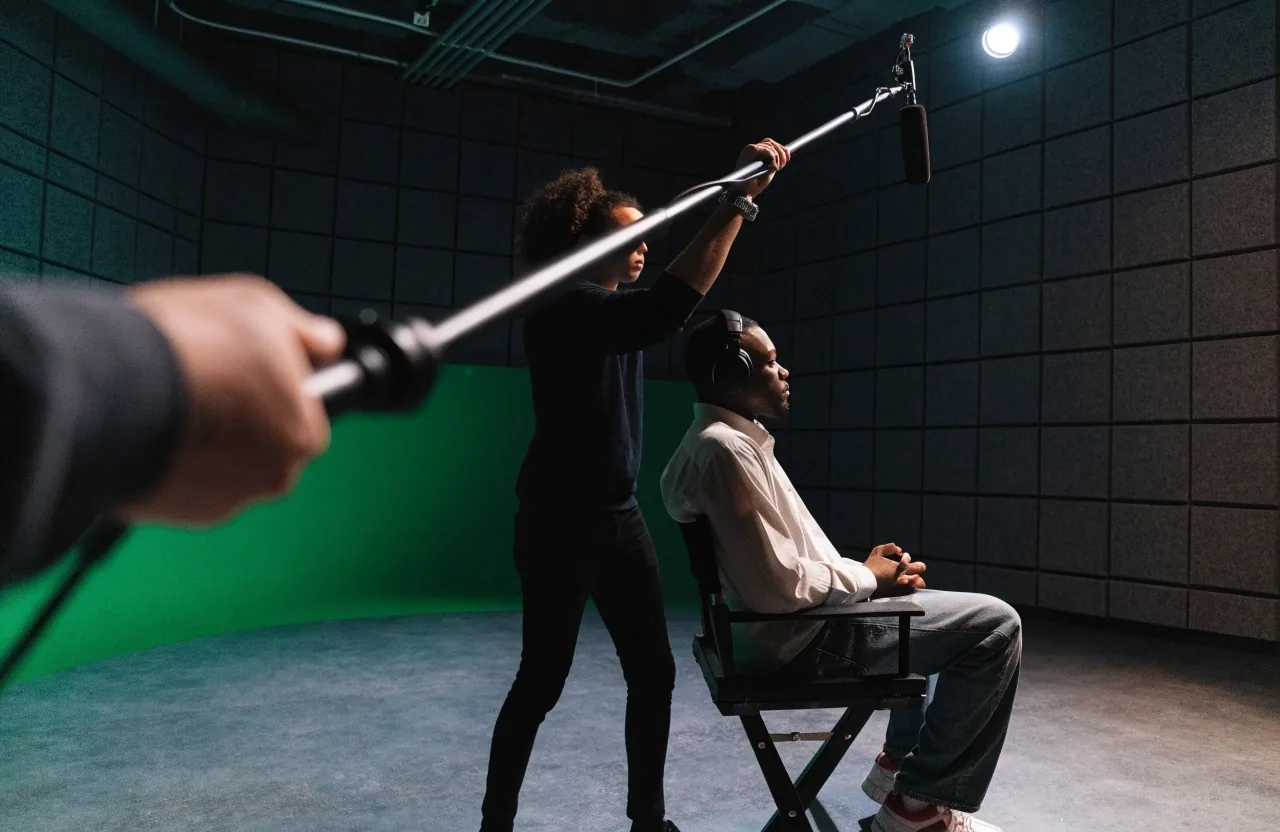
The control room monitors and guides the speaker via headphones. Pauses for retakes are possible at any time; takes are logged.
Review
Review and pre-selection
Usable takes are separated from errors. If you want to edit yourself, you will receive the files with notes.
Post-production
Post-production and approval
Editing, audio adjustment, and output in the target format. For sensitive interviews, we clarify in advance who provides the approval.
Delivery
Delivery and archiving
Handover in the agreed format, if necessary in multiple versions. Storage is based on the DPA or the order.
Hybrid
Special case: hybrid production
For hybrid productions, we check remote connection, audio return, and responsibility in case of failure in advance. This applies especially to guests connected via third-party platforms.
Setup on the day of the shoot and recording
On the day of the shoot, the recording room is set up according to the plan. Microphones, lighting, camera, and seating are checked before the first guest arrives. If a guest needs to sign a release form, the document is ready. For live recordings, we check the audio loop and the remote connection before the stream starts. The setup is routine, but it is never skipped.
During recording, the control room monitors the session, and the speaker is guided via headphones. You can pause during the recording to repeat something or let it run through. We log the takes so that it is clear later what is usable and what is not. For live recordings, the session follows the agreed workflow; deviations are discussed in the control room.
After the recording, we review the material. For interviews, this means we separate usable takes from errors. For voice recordings, it means we mark repetitions and slips of the tongue. This pre-selection is not editing in the strict sense, but an organization that shortens post-processing. If you want to edit yourself, you will receive the files with notes.
Post-production and approval
If post-production is requested, it is carried out here. This includes editing, sound adjustment if necessary, and output in the target format. For projects involving personal data, we clarify who provides approval before output. For interviews on sensitive topics, guest approval may be required before anything leaves the studio.
Delivery and archiving
The finished files are delivered in the agreed format. If required, in multiple versions, for example for broadcasters and the web. You or the project decide on storage; we adhere to what is stipulated in the DPA (Data Processing Agreement) or order. If material is needed again at short notice, please let us know while it is still available.
What delays the process
Delays rarely occur at the microphone, but rather at the edges. A guest without approval, a target format that is only mentioned on the day of the shoot, a connection that could not be tested. Each of these situations is solvable, but it costs time that is missing on the day of the shoot. That is why the preparation phase is the most important part of the process.
Frequently asked questions about the production process
How long does a typical interview production take?
That depends on the project type and preparation. A short statement often requires a short period of time; for a longer interview, please plan for more. We will clarify the exact framework after your inquiry, as setup and preparation are included.
Can I pause during the recording?
Yes. You can interrupt at any time to repeat or rephrase something. The director logs the takes so that the later selection does not become laborious.
Do I get raw material or edited material?
Both are possible. For projects without post-production, you receive the files with notes for pre-selection. For projects with post-production, we deliver the finished result in the agreed format.
Who gives the approval for the output?
This is project-specific. As a rule, it is the client; for interviews with sensitive topics, the guest's consent may also be required. Clarify this before the shoot, as it affects delivery.
Next step: Clarify the process for your project
If you would like to know what the process looks like for your specific project, send a short inquiry. We will get back to you with an assessment and, if necessary, suggest an adapted schedule.
Get in touch
Address
Kastanienallee 42, 10435 Berlin
Phone
+49 30 12345678Opening hours
Monday to Friday, 09:00–18:00